
Love Is the Answer
Happy Father's Day

About a year after he died in 2014, I dreamed of my father.
We were at some sort of outdoor family gathering. He was seated in a lawn chair a few yards away from the group. I approached him. I told him I was worried about my own, almost adult, children, and gave several reasons why.
He told me not to worry, that everything would be resolved with the help of my children’s friends. I tried to explain that it was more complicated than that. My father didn’t know my children’s friends. They had problems of their own. How were they supposed to help? But my father just smiled and nodded wordlessly, in a way that he often did, as if to say, “Trust me, I know.” Just as I began to get frustrated, my father broke into song.
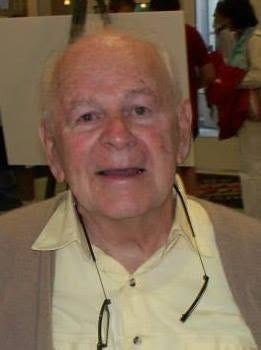
It was not out of character for my father to start singing in the middle of a conversation. He was a trained singer, a baritone, and he knew a lot of songs. But the voice he sang with in my dream was not his voice. It was a voice he dreamed of having, that of the operatic tenors he loved, soaring above an invisible full orchestra, singing, “Love is the answer. Once you’ve found it. Build your world around it.”
Then I woke up. I struggled to name the song my father was singing. In a few minutes it came to me. It was “Make Someone Happy.”
This was definitely not one of the songs that my father used to sing when he was alive. Nor was it a song I had heard recently or even particularly liked. It was one of those show-biz crooner songs. I associated it with the boring, unfunny parts of the variety shows I used to watch on TV as a child in the 70s. The sublime version in my dream was unlike any I had ever heard before.
Also, in my dream the lyrics were altered. The original lyrics (by Betty Comden and Adolph Green) were “Once you’ve found her, build your world around her.” Sometimes the “her” was changed to “him,” depending on who was singing, but it was always about finding romantic love. The change of pronoun, from “her” (or “him”) to “it,” made the song about something else.
My father, like me, went by the name of David Torbett. But I am not a “junior.” Our names are not exactly the same. My full name is David James Torbett. My father’s full name was Walter David Jessee Torbett.
My father was the youngest of his siblings. Four names are a lot for a little boy. With too many names to choose from, his siblings and other family members opted not to use any of them. For the first five years of his life, my father was known only as “Papoose.”
The day before Papoose enrolled in kindergarten (or was it first grade?) his older brother, my uncle Gilbert, told him that when he went to school he could no longer go by “Papoose.” He had to choose one of his names. He chose “David” because he liked the sound of it better than “Walter.”
That was the story he told, anyway. In some renditions, he chose “David” over “Walter” because Walter was the name of the town drunk.
My father told a lot of stories. He had stories of his career as a judge. Our favorite was the “flag desecration” incident of Johnson City, Tennessee. There was no actual flag desecration. There was, however, an overzealous sheriff, a college student who looked like a hippie but wasn’t really, a daughter of a Nixon cabinet member, and a cat. He also had stories of his loving, often happy, often chaotic, sometimes tragic family life. His mother was institutionalized with schizophrenia when he was a baby. His father died in a car accident when he was in college. My father was raised largely by his aunt Frances, whom Gilbert (and therefore everybody else), called “Bugs.” Dad’s family had a knack for nicknames.
But any event in my father’s life, even a conversation with a stranger he had that day, could become a story. He had that way about him, with his deep voice and his broad East Tennessee accent. He was also a huge football fan, especially of the Tennessee Volunteers. He smoked cigars. He gave them up when I was young, but the memory of the aroma is strong. He was a Republican, patriotic and conservative in politics. As a child I thought that every dad was a Republican who loved football, cigars, and opera—four things I didn’t understand, so I assumed they were all necessary mysteries of the adult, male world.
My dad, it is safe to say, was a character. But he was also a vulnerable human being. And for a southern, Republican, football-loving man of his generation, he was remarkably unafraid to show it. He spoke openly about how the traumas of his childhood affected him. He did not hesitate to seek psychotherapy when a bad reaction to anesthesia from shoulder surgery sent him into depression. This vulnerability was part of what made him a great dad. He understood his own need for security, love, and happiness, and he sought to provide those things for his children.
And he did. When my brother and sister and I needed a father, when we needed his help, his wisdom, his comfort, his assurance, as children and as adults, we could always go to him. And he would always help us however he could, just as long as he was able.
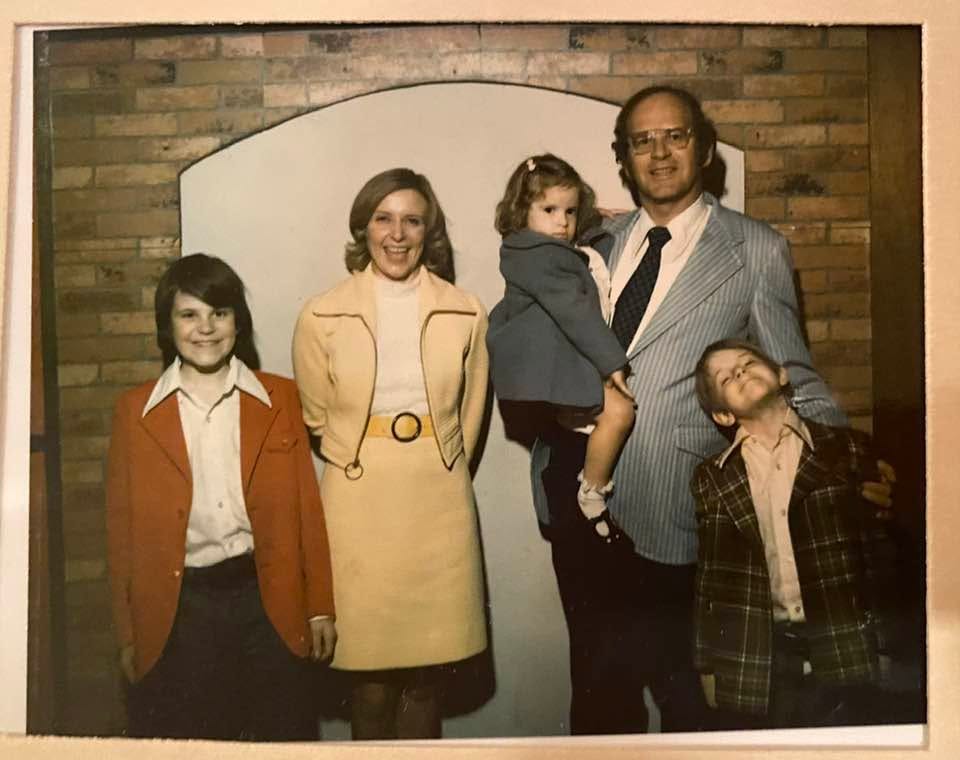
When he died, I wished I could go to him one last time. And I like to think I did—in that dream of mine. I don’t normally put a lot of stock in dreams or communications from beyond the grave. Despite my vocation as a religion professor and my ordination as a minister, I have a pretty strong skeptical streak. That’s another thing I get from my dad.
But something about the dream felt very right. Love is the answer. Not just romantic love, but love itself, that deep abiding power that fills the universe, that heals our wounds and binds us together. Once you’ve found it, build your world around it. That’s how to help the world find happiness. And when you do, you will be happy too.
I could never prove (or disprove) that my father came to me in a dream to give me that message. But the fact is that he had already delivered that message to me with his words and actions throughout his whole life.
So, I’ll take it.
Happy Father’s Day.
Thank you David! This is a precious gift!
Perfect, as always, David. Thank you for your sincere and thoughtful tribute to your father AND for the wise words of wisdom. MMcG