
Is It Ever Over?

David made a very bad mistake.
David, the one who defeated Goliath, the one who played the harp and wrote psalms, the great king of Israel—that David—made a very bad mistake when he slept with Bathsheba.
It was wrong in so many ways. It was not only adultery. It was an abuse of power—against Bathsheba (she appears to have had no choice in the matter) and against Uriah, her husband.
And anyway, what was the king doing, lingering on the palace rooftop, ogling a bathing woman, while Uriah was off with the army fighting David’s battles for him? It was wrong, David knew. It shouldn’t have happened. But it was done. It was over.
Except it wasn’t over. In a few days Bathsheba sent word to David, “I am pregnant.”
David scrambled for a solution to this new problem. He brought Uriah back from the battle front. He encouraged Uriah to go home and “wash his feet,” a euphemism for having sex. If Uriah would just sleep with his wife, then Uriah would think that the child to be born is his, and no one will be the worse for it. It will be over.
But it wasn’t over. Uriah refused to sleep with his wife in his house in a comfortable bed while his fellow soldiers were camped in the open fields, not even after David got him drunk. Uriah bunked for two nights with the king’s servants before he returned to the battlefront. So, David had to try something else—a desperate measure.
David called on his general Joab, the kind of person you call when you’re ready to take desperate measures. Joab, on David’s instructions, ensured that Uriah was killed by the enemy in battle.
Now it has gone from bad to worse, from adultery and abuse of power to murder. But with Uriah being dead, David can marry Bathsheba, and no one will question where their child came from, and at last the whole episode will be over.
But no, it’s not over. The LORD sends the prophet Nathan to accuse David. Nathan skillfully does so by telling David a story, forcing David to acknowledge his crimes and condemn himself. David confesses all and repents. Confession is painful but good for the soul. Now that David has come clean, perhaps God will forgive him, and then the whole ordeal will be over.
Yes, God does forgive David, but no, it is not over. Even divine forgiveness cannot stop the avalanche of consequences of David’s abuse of power, sexual imposition, and violence. David does not die for his sin, but the child of David and Bathsheba dies. David grieves, but faces the child’s death with resignation. There is no bringing him back, and now at last, perhaps the whole tragic affair would be over.
But it is just the beginning. As Nathan predicted, the sword would never depart from David’s house. The violence and tragedy that David brought on Bathsheba and Uriah would be visited on David’s own family.
First, there is incestuous rape. David’s son Amnon rapes his half-sister, David’s daughter Tamar. Then there is revenge murder. Tamar’s full brother, Absalom, kills Amnon. Then David banishes Absalom from the kingdom.
Then Joab, David’s general and hit man (and one of the most complicated characters in the Bible) takes on the role of David’s family therapist, and persuades David to allow Absalom to return to Jerusalem.
Although David has been yearning for his son Absalom in his absence, he refuses to speak to him when he returns, or even allow him into his presence for two years, until Joab again intercedes and arranges a meeting between father and son. Absalom prostrates himself before David. David kisses Absalom. The two appear to be reconciled. Is the tragic conflict at last over?
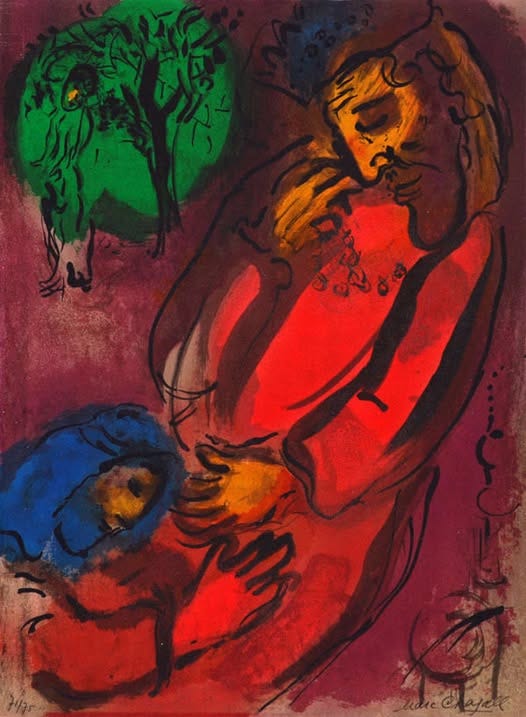
No. Absalom, handsome (with his long David Lee Roth hair), charismatic, and ambitious Absalom is still angry. He named his daughter Tamar, after his violated sister.
Absalom foments a rebellion against King David. Using his charm, and exploiting David’s political weaknesses, Absalom wins the hearts of the people of Israel. The rebellion is so successful that David, with his remaining loyal supporters (including Joab) are run out of town, and Absalom takes over the palace.
After several more dramatic twists and turns, David’s army is prepared to face Absalom’s in battle. In front of the whole army, David gives final instructions to Joab and his other generals. But his speech is not a rousing call to arms. It is a father’s plea. “Deal gently for my sake with the young man Absalom.”
They don’t.
Absalom gets his beautiful long hair stuck in the branches of a tree, and his mule bolts out from under him. Absalom is left, vulnerably “hanging between heaven and earth.” David’s soldiers hesitate, remembering David’s command. Joab doesn’t hesitate. He thrusts three javelins into Absalom’s heart. After Joab’s first strike, the others join in. Absalom is dead. All that remains is to tell the king.
The messengers hesitate. They emphasize the good news, that the rebel army has been defeated. But David keeps asking, “Is it well with the young man Absalom?” “Is the young man Absalom safe?” When the questions can no longer be avoided, the Cushite messenger answers indirectly, “May the enemies of my lord the king and all who rise up to do you harm be like that young man.”
David gets it. He trembles. He weeps. He says the saddest words he has ever spoken. When the former King Saul and his son Jonathan died, David grieved with poetic eloquence, eulogizing about how the mighty have fallen. When the newborn infant of David and Bathsheba died, David was resigned, saying, “I shall go to him, but he will not return to me.” When Absalom dies, David has no capacity for eloquence. All he can do is say his name “Absalom,” and “my son” over and over again. David cannot be resigned to reality. He can only wish the impossible: “If only I had died instead of you.”
Throughout the whole catastrophe, David has just wanted it to be over. Now the consequences of David’s misdeeds, all predicted by Nathan, have run their course, but David is not ready. He wants to go back, to make things turn out differently. Most of all, he wishes that he could have died instead of Absalom. But it is too late. It’s over.
But in another sense, David knows that it is never over. Absalom is dead, but David has to live, and he still has to be king. Joab, the pragmatic one, reminds David of this, telling David to snap out of it. David listens, and swallows his private grief to do his public duty. He reenters the conflicted and confusing sphere of royal politics that he can never leave behind.
There is a reason why we are not as familiar with this story as we are with other stories in the Bible, like the story of David and Goliath. We humans like our stories, especially our religious stories, to be simple, with distinct good guys and bad guys, with a clear beginning and a triumphant ending.
But this story is none of those things. It has all the ugliness, the power struggles, the deception, the infighting and the ambivalence of politics. No “guy” in this story is completely good, not even the great King David. Nor is there one who is completely bad, not even the ruthless Joab.
This story is full of contingencies. Every active character in every scene keeps making choice after choice. Each time they could have chosen differently, and turned the course of events in a different direction. Despite Nathan’s prophetic predictions, no event in this story seems inevitable. And for that reason, nothing feels complete, finished, over.
In other words, this is real life. That is why it is so important that this story is in the Bible (in Second Samuel 11–19, to be exact). God belongs in this story, because it is a human story. There is no aspect of human nature or human experience that is foreign to God. God is present in our real, contingent, complicated, sinful and tragic lives.
God is present, not only in the triumphant world of David and Goliath, but in the shady world of David and Bathsheba, of Uriah and Joab, of Amnon and Tamar and Absalom. If God is not part of this world, God is not part of any world, and God offers no hope for redemption.
And there is hope for redemption in this story, because it is part of a larger story. It is the story of God, who created human beings in the divine image. It is the story of God calling a special people, Israel, to be a light to the world. It is a story of God working with the human race in general and God’s chosen people in particular, with their gifted and anointed and flawed leaders, as they strive and fail and strive again to bring about God’s intention, a community of people who freely love and live and thrive together with God and each other.
How many times in the past month, the past year, the past five years, the past ten years, have we asked ourselves, “will this ever be over?” When will the undeclared and unjustified war with Iran be over? If the bombing were to stop tomorrow, would the conflict and its consequences really be over? When will US-government sponsored violence, at home and abroad, be over? When will racial injustice ever be over? When will the ecological crisis be over?
For that matter, when will any personal struggle that any of us are going through ever be over? When is a physical health crisis over? When is a mental health crisis over? When is a family conflict over?
I don’t know. But there is another side to things apparently never being over. God is not done with us yet.
This is important to remember, especially today, Good Friday—when Christians remember the brutal death of Jesus, and await the surprise of resurrection on Easter.
This is important to remember during this week of Passover, when Jews remember the redemption of the Israelites from slavery in Egypt, and anticipate the surprising redemptive work of God “in every generation.”
When there is no end in our sight, God may have a surprise ending in store for us that is greater than anything we could imagine.
And will this Substack ever be over? Yes. Now. Amen.
A wonderful reminder. Thank you for writing.
David T. always brings ideas and something to really think about. So glad to read his words!